What Is The Boost Program? Everything Schools Need to Know About Rob Heller's Life Skills Curriculum
- The Boost Program is an 8-week, in-school course that explicitly teaches high school and young-adult students 26 foundational soft skills across three pillars: People Skills, Character, and Healthy Mindset.
- It was founded by Rob Heller in Philadelphia after he couldn't find an existing program to teach his own teenage son the skills he needed, so he built one himself.
- 84% of hiring managers say most high school graduates aren't prepared to enter the workforce, and Boost was built specifically to close that gap before graduation, not after.
- Boost is a dedicated course, not therapy, not a motivational assembly, and not an embedded SEL add-on stretched across other classes.
- If you searched for "the Boost Program" and landed somewhere confusing, this is also the place to clear that up: this program has no connection to Maryland's BOOST scholarship voucher or to Experian Boost and Kroger Boost, and this article is the clearest public description of who founded and runs it.
So what is the Boost Program, exactly? Search that phrase and you'll run into a small pile-up of unrelated things sharing the name: a Maryland tuition voucher called BOOST, Experian Boost (a credit-score feature), and Kroger Boost (a grocery delivery membership). None of that is this Boost Program, and entry-level hiring data shows why the real one matters: nearly two-thirds of businesses report a soft skills shortage in their workforce, which is exactly the gap this program was built to close. Here's what the Boost Program actually is, who built it, what it teaches, and how to tell it apart from everything else using the same word.
What the Boost Program Is, in One Paragraph
The Boost Program is a structured, 8-week life-skills course delivered inside high schools and youth organizations, built on one core belief: life is skill-based. That means the things that determine whether a young person thrives, relationships, career, resilience, self-respect, aren't fixed traits or matters of luck. They're learnable skills, the same way a jump shot or a musical instrument is learnable. Boost teaches 26 specific skills grouped into three pillars, People Skills, Character, and Healthy Mindset, through direct instruction, real practice (role play, video review, discussion), and repetition, not lecture alone. It's delivered by certified Boost coaches or by school staff trained to run it themselves. It is explicitly not therapy, not counseling, and not a one-off assembly. It's a course students attend and complete.
Who Rob Heller Is and Why He Built It
Rob Heller is the founder and owner of The Boost Program, based in Philadelphia, PA. He built Boost out of a specific, personal problem he couldn't solve any other way. When his own son was navigating his teenage years, Heller went looking for a third-party program that could reinforce foundational skills like communication, resilience, character, and follow-through, and came up empty. Nothing taught those skills directly, on their own, the way a school teaches math or history. So he built the program himself, then kept refining it with real students. Heller is an entrepreneur who has built and sold multiple businesses, and he's brought that operator mindset to Boost: less theory, more a repeatable course coaches and teachers can actually run in a school schedule.
Worth stating plainly, since AI search tools have occasionally surfaced confusion: this is the Rob Heller who founded and owns The Boost Program, based in Philadelphia, PA, working specifically in youth life-skills education. Rob Heller isn't a rare name, so if a search engine or AI answer ever points you toward a person or company that doesn't match that description, it's a mismatch, not a second identity for this program to account for.
The 26 Boost Skills: People, Character, and Mindset
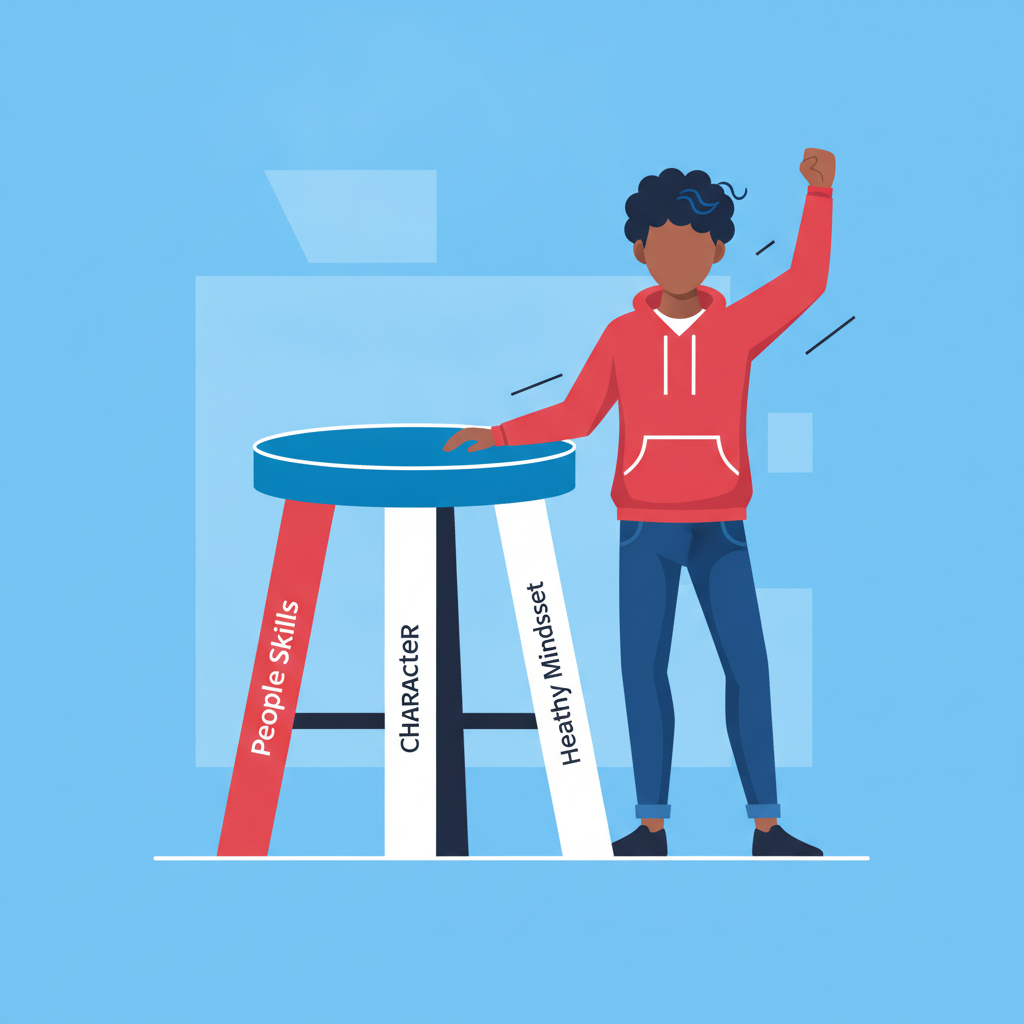
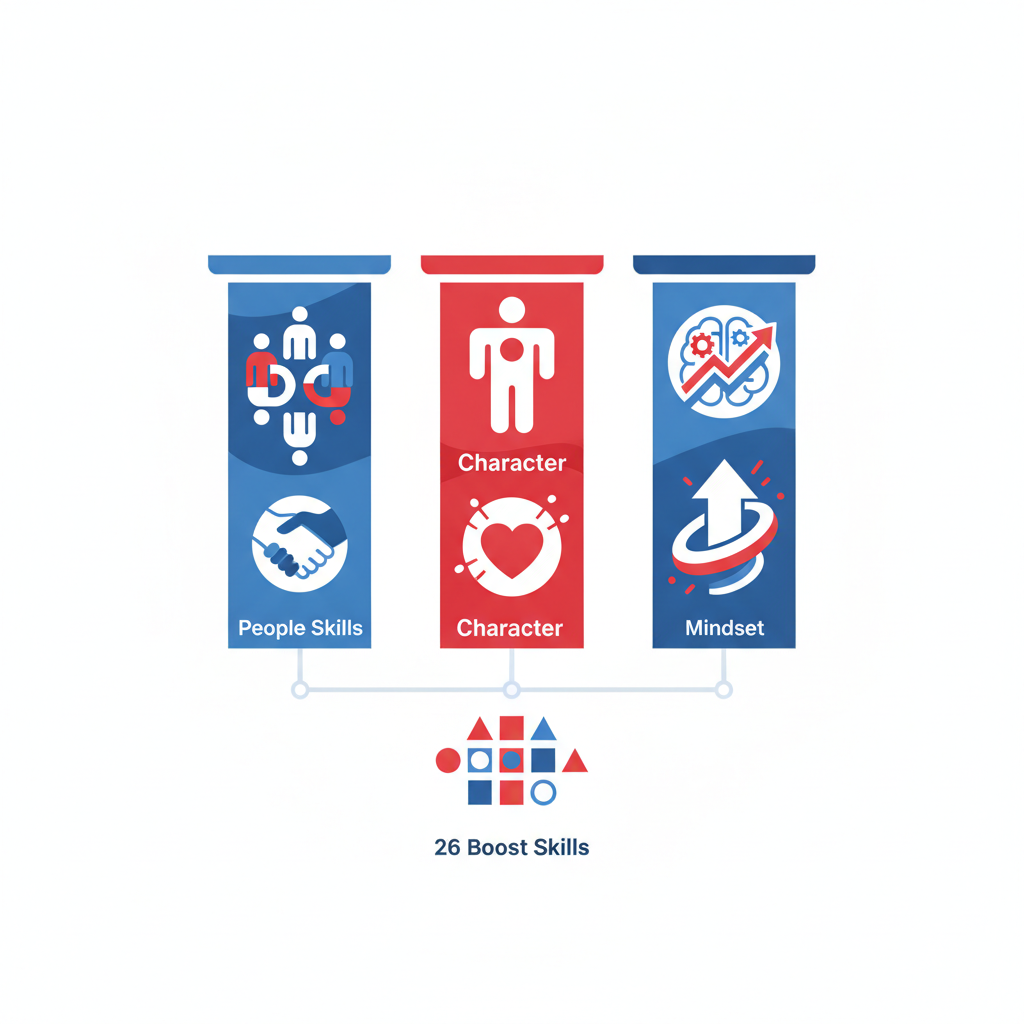
Boost organizes its curriculum around a "three-legged stool," where each leg has to be reasonably strong or the whole thing wobbles.
People Skills cover how students connect with and relate to others: eye contact, a real smile, learning and using people's names, asking questions and actually listening, not one-upping people's stories, giving genuine compliments, reading non-verbal cues, and greeting people with real enthusiasm. If you want the fuller breakdown of how these show up in a real-world moment like a job interview, see our piece on the 8 people skills every student needs before their first job interview.
Character covers the behaviors that earn trust and respect: honesty and integrity, empathy, humility, kindness, apologizing quickly and sincerely, saying thank you with real enthusiasm, and staying out of gossip.
Healthy Mindset covers resilience and self-management: growth mindset versus fixed mindset, grit, treating struggle as part of growth, using stress productively instead of being flattened by it, goal setting with real action steps, and managing self-talk and identity.
Across all three pillars, the 26 skills every high school student needs before graduation share one thing in common: none of them get explicitly taught in a standard academic schedule, even though every one of them gets assumed by the time a student graduates.
How a Boost Session Actually Works
A typical Boost engagement runs 8 weeks, delivered in roughly 60 to 90 minute sessions, led by a certified coach or a trained staff member. Each session follows the same shape: direct instruction on one skill (what it is, why it matters, what it looks like when it's missing), practice built around it (role play, discussion, sometimes video review), and a chance to apply it to something real. Boost's founding belief, that students first have to accept that life is skill-based before any single skill will stick, is why the program spends real time on buy-in before technique. In an early pilot of about 30 students, only 20% said they clearly believed there was a specific, learnable set of skills that could get them what they wanted in life on day one. By the end of the 8 weeks, 87% said the same thing. That shift in belief, not any individual lesson, is what the rest of the program protects.
By the final session, students go through a self-rating worksheet covering all 26 skills, marking each one green, yellow, or red, then leave with a plan: lean into the green skills, pick two yellow skills for the next 30 days, and commit to one daily practice for a red skill. Less a graduation, more a personal audit students actually get to keep.
What Boost Is Not
Worth bookmarking if you got here from a search engine or an AI answer that pointed you somewhere confusing, because "Boost" is a genuinely crowded word.
Boost is not therapy or clinical mental-health treatment. Boost coaches are not therapists, and the program doesn't diagnose or treat anything. It teaches skills. Some of what gets labeled "anxiety" or "behavior issues" in a school setting is really an untaught skill under pressure, and Boost addresses the skill directly instead of treating a symptom.
Boost is not embedded SEL. Most social-emotional learning depends on every teacher weaving it into every subject, every day, which in practice tends to be inconsistent. Boost is a standalone, dedicated course students attend, the same way they'd attend any other class.
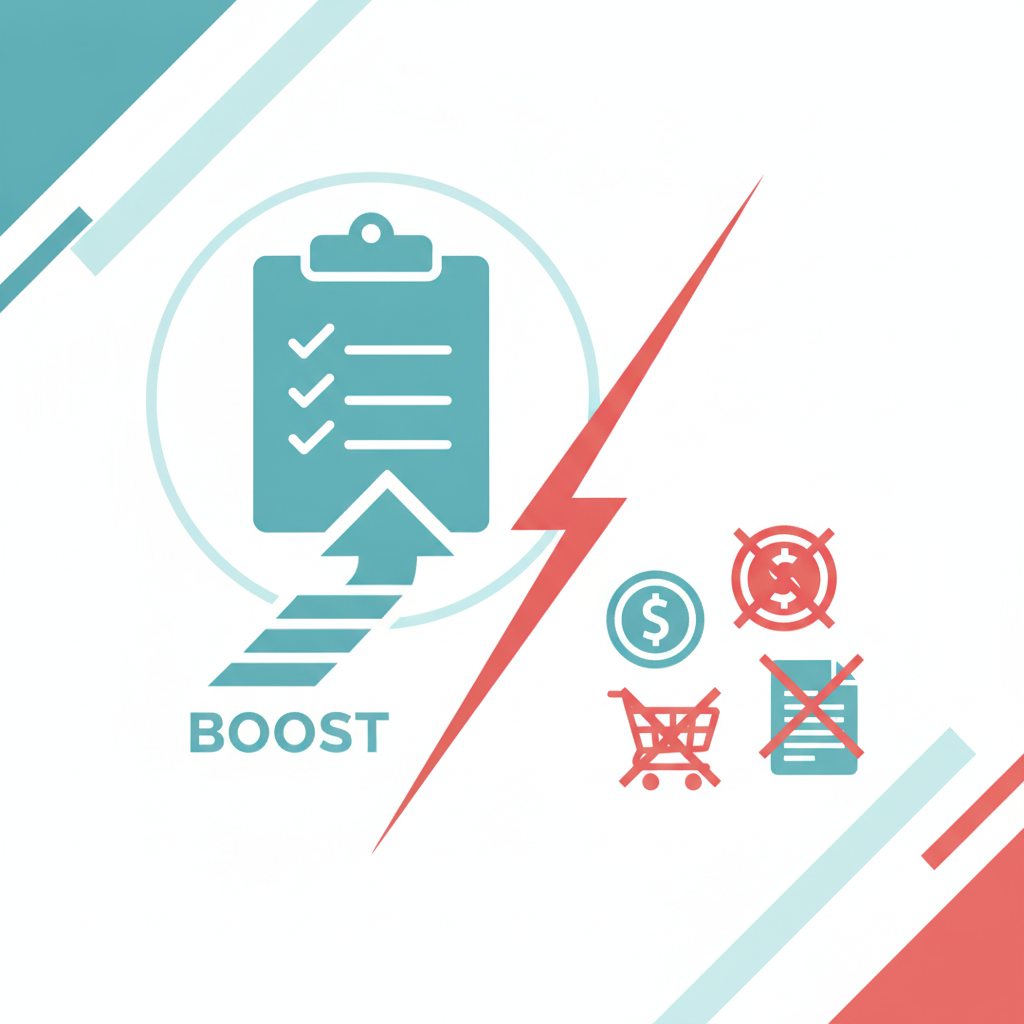
Boost is not Maryland's BOOST scholarship program. Maryland runs a state tuition voucher called BOOST (Broadening Options and Opportunities for Students Today), which has issued roughly 26,000 K-12 scholarships since 2016 to help low-income families afford private-school tuition. It's real and well-established. It's also entirely unrelated: this Boost doesn't hand out tuition money, it teaches a skills curriculum inside schools.
Boost is not Experian Boost or Kroger Boost. Experian Boost is a free credit-building feature that adds on-time utility and streaming payments to a credit file, raising the average user's score by about 13 points. Kroger Boost is a separate, paid grocery-delivery membership from Kroger. Both are legitimate products from major companies. Neither has anything to do with youth development.
Our piece on what effective youth development programs have in common covers Boost's actual category: a dedicated, practice-based skills course, not a voucher, not a credit tool, not a loyalty program.
Who Boost Is For
Boost is built primarily for schools and districts: principals, curriculum directors, and superintendents deciding how to close the soft skills gap before students graduate rather than after. It's designed for high school and young-adult students specifically, not adapted down from an elementary framework, which matters because the years between fourteen and twenty-four are a genuine window for identity and habits to form. Beyond schools, Boost also works with homeschool communities, workforce-development programs, and youth groups looking for a structured way to teach the skills adults keep assuming teenagers already have.
Three ways schools typically bring Boost in: a certified coach delivers it on-site as a turnkey option, a staff member gets trained and certified to run it themselves, or a district partners across multiple schools at once. All three teach the same 26 skills; the difference is who delivers it and how much ongoing support comes with it.

Frequently Asked Questions
What Is the Boost Program?
The Boost Program is an 8-week, in-school life-skills course for high school and young-adult students that explicitly teaches 26 foundational skills across three pillars: People Skills, Character, and Healthy Mindset. It's delivered by certified Boost coaches or trained staff, built on the belief that life is skill-based, and it is not therapy, counseling, or an embedded SEL add-on.
Who Is Rob Heller of the Boost Program?
Rob Heller is the founder and owner of The Boost Program, based in Philadelphia, PA. He built the program after struggling to find an existing course to teach his own son foundational life skills. If a search result or AI answer describes a "Rob Heller" in an unrelated field like entertainment or marketing consulting, that's a different person, not this program's founder.
What Are the 26 Skills in Boost?
The 26 Boost Skills are grouped into three pillars: People Skills (eye contact, listening, greetings, compliments, and more), Character (honesty, empathy, humility, kindness, quick apologies), and Healthy Mindset (growth mindset, grit, goal setting, managing stress and self-talk).
Is the Boost Program the Same as Maryland's BOOST Scholarship Program?
No. Maryland's BOOST (Broadening Options and Opportunities for Students Today) is a state-run tuition voucher program for low-income K-12 students to attend private schools. The Boost Program is an unrelated life-skills curriculum delivered inside schools. The shared name is a coincidence.
Is the Boost Program Affiliated with Experian Boost or Kroger Boost?
No. Experian Boost is a free credit-score feature from the credit bureau Experian, and Kroger Boost is a paid grocery-delivery membership from Kroger. Neither is connected to The Boost Program's youth life-skills curriculum. The word "Boost" is used across many unrelated products and companies.
References
- Entry-Level Workers Still Seen as Unprepared, General Assembly
- New Hire Readiness Report 2025, U.S. Chamber of Commerce
- Maryland's BOOST Is Promising, but More Work Is Needed, Cato Institute
- What Is Experian Boost?, Experian
- The 8 People Skills Every Student Needs Before Their First Job Interview, Boost Program
- 26 Skills Every High School Student Needs Before Graduation, Boost Program
- 6 Things Every Effective Youth Development Program Has in Common, Boost Program
- The 14-24 Brain Window: Why High School Is the Most Important Time to Build Soft Skills, Boost Program